 checkwhendone.comPrint and check things when done
Put the habit on paper.
Print a tracker and hang it where you can't miss it. Check a box every time you follow through, and let the paper keep score.
Create your sheet- Free
- No account
- Prints on one A4 page
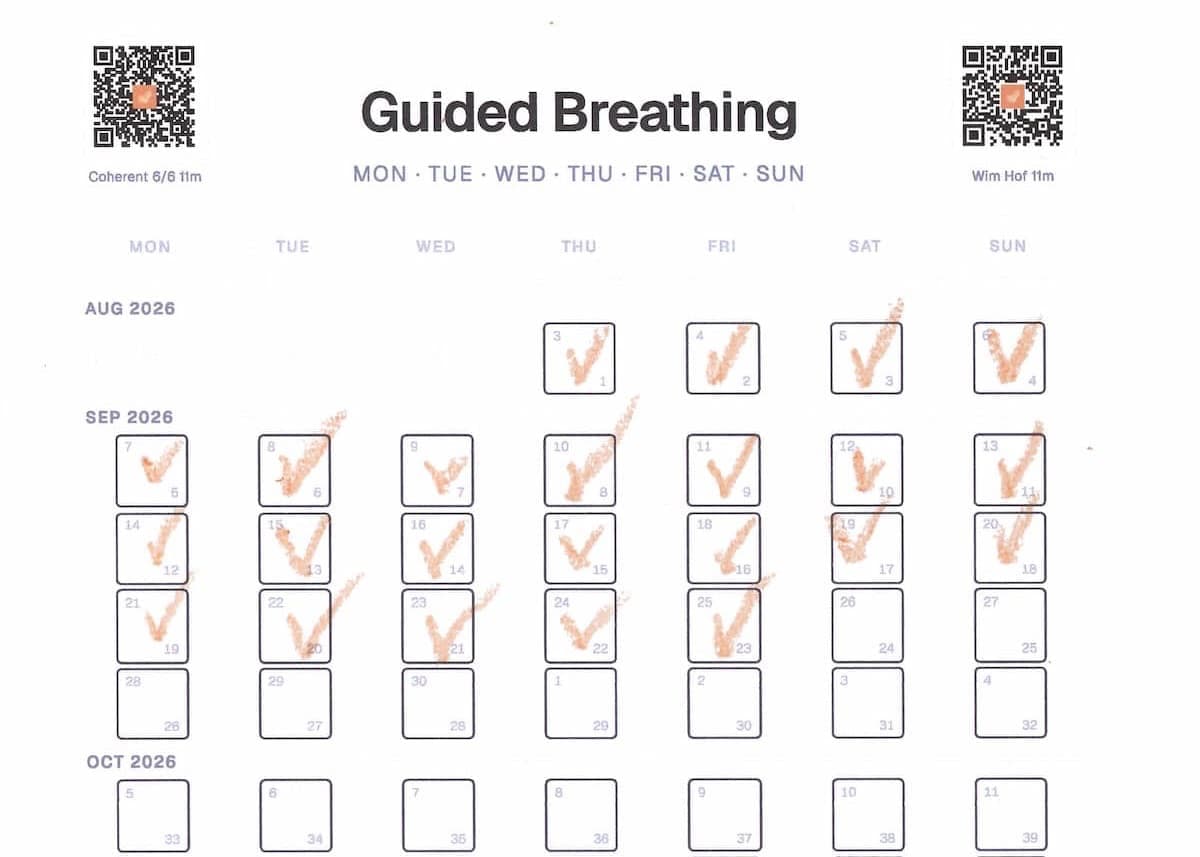
Schedule or simple
Pick your active weekdays and every box gets its real date, or keep it a plain numbered grid you fill at your own pace.
Always one page
A live preview while you tweak. Print one A4 sheet, or two A5 copies side by side to cut in half. Whatever you set up is guaranteed to fit.
Share as a link
The whole sheet lives in the URL. Send it to someone, or keep it to reprint the next batch with numbering continued.
Daily rules
Add up to six numbered rules below the boxes, so the sheet says exactly what counts as done.
Links as QR codes
Add up to three links and they print as QR codes on the sheet. Scan one with your phone to open a demo video, a recipe, or a playlist.
Scan to reprint
Every sheet prints a small Print more code in its bottom right corner. Scan it to open the same sheet again and print the next copy.
Why repetition?
How long does it take to form a habit?
There isn't a universal number.
In one real-world study, people repeated a new behavior daily in a consistent context. Among participants whose habit development could be modeled reliably, the median estimated time to reach 95% of maximum automaticity was 66 days. The middle half of estimates was roughly 39 to 102 days, and modeled estimates ranged from 18 to 254 days.
The takeaway isn't "66 days." Habit formation is gradual and highly individual. In the same study, missing one opportunity did not appear to materially disrupt the process.
CheckWhenDone does not promise that a habit will form after a certain number of checks. The checks help you repeat the behavior and make your progress visible.
Lally et al. (2010), How are habits formed: Modelling habit formation in the real world, European Journal of Social Psychology. DOI: 10.1002/ejsp.674
Have an idea? Send feedback or upvote an existing one
A bug, a missing option, an idea for a sheet: all welcome. It goes straight to the person who wrote the code. Ideas already under consideration are listed on the feedback page, where one vote from you helps decide what gets built first.
See the ideas and votePrefer email? [email protected]